Understanding AR-15 Gas Systems
What This Article Covers
This guide explains how AR-15 gas systems work, why gas system length matters, and what tradeoffs exist between reliability, recoil, and parts wear. It is written to help new builders understand the system-level decisions behind barrel and gas system pairing.
Key takeaways
- Gas system length changes port pressure and dwell time.
- Short systems are reliable but can feel sharper.
- Longer systems often shoot softer on matching barrels.
- Suppression adds back pressure and can require tuning.
How AR-15 Gas Systems Work
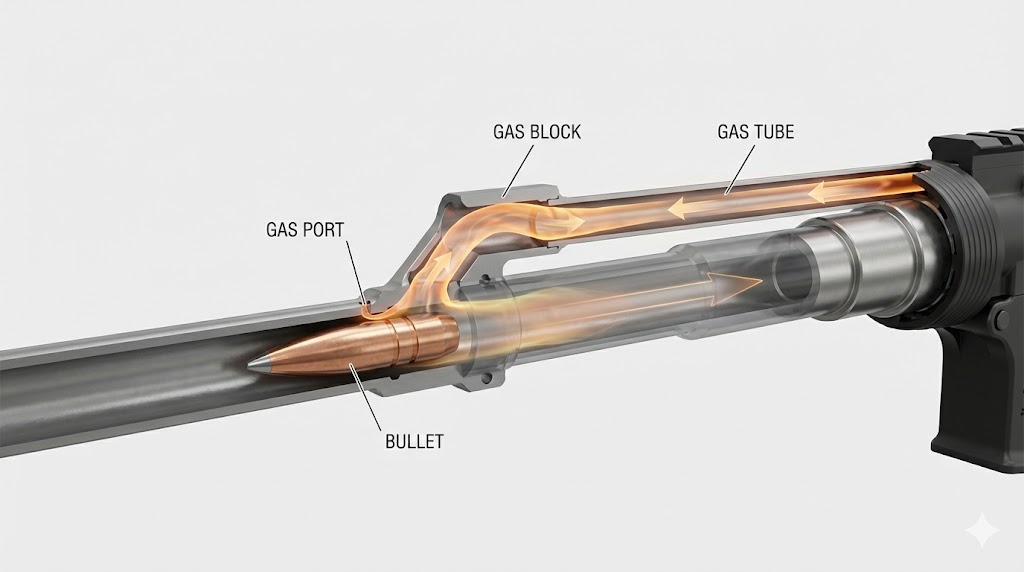
When a round is fired, a small amount of gas is tapped from the barrel through the gas port Gas port: the small hole drilled in the barrel that directs gas into the gas system.. That gas travels through the gas block and gas tube into the carrier key, pushing the BCG Bolt carrier group (BCG): the moving assembly that cycles the action, extracts the case, and chambers the next round. rearward. The carrier unlocks, extracts the case, and cycles the action.
The timing of this sequence depends on where the gas port is located and how long the bullet remains in the barrel after passing the port. Gas system length changes both the pressure at the port and how long gas is available to operate the action.
Gas System Lengths: The Options
Pistol-Length
Pistol-length ports are typically 4-6 inches from the chamber and are common on very short barrels. Because the port is close to the chamber, pressure is high. These systems need that pressure to function reliably on short barrels but can feel sharp and fast compared to longer systems.
Carbine-Length
Carbine-length ports are around 7.5 inches from the chamber and are common on 10.5-16 inch barrels. This is the most common gas system length due to long-standing military and commercial use. On 16-inch barrels it can be on the “overgassed” side for some ammo, but it remains widely used because it is proven and reliable.
Mid-Length
Mid-length ports are around 9 inches from the chamber and are common on 14.5-18 inch barrels. The longer distance reduces port pressure and often results in a smoother recoil impulse on 16-inch barrels. This has made mid-length a popular choice for general-purpose builds where softer cycling is desirable.
Rifle-Length
Rifle-length ports are around 12 inches from the chamber and are traditional for 20-inch barrels. This system has the lowest port pressure and tends to be the smoothest when paired with the correct barrel length. It remains common on full-length rifles and precision-focused builds.
What “Dwell Time” Means and Why It Matters
Dwell time is the time between the bullet passing the gas port and exiting the muzzle. During this time, the system is pressurized and gas continues flowing into the carrier. Think of it as how long the system has to do its work.
Longer dwell time Dwell time: the interval between the bullet passing the gas port and exiting the muzzle, when the system is still pressurized. means the system has more time to do its work, which allows lower port pressure Port pressure: gas pressure at the gas port when the bullet passes it.. Short dwell time requires higher pressure to cycle the action. This affects carrier speed, recoil feel, ejection pattern, and parts wear.
Port Pressure and Overgassing
Manufacturers often drill gas ports on the large side to ensure reliability across different ammo types. The downside is overgassing, which can show up as harsh recoil, fast ejection, and increased wear on the buffer and bolt carrier group.
Overgassing is a reliability tradeoff, not necessarily a defect. It ensures the rifle cycles under adverse conditions but can be less pleasant to shoot. In this context, overgassing Overgassing: a condition where excess gas drives the action too hard. Symptoms include harsh recoil and brass ejecting sharply forward (1-2 o'clock). is a symptom of tuning for worst-case reliability.
Gas Port Size
Gas system length is only part of the equation. Port size determines how much gas is available to drive the system. A carbine-length system with a small port can feel smoother than a mid-length system with an oversized port. This is why two barrels with the same length and gas system can feel different in practice.
Why Adjustable Gas Blocks Exist
Adjustable gas blocks allow builders to reduce gas flow and tune the system for a specific load, barrel, or suppressor. This can make the rifle smoother and reduce wear, but it adds complexity and requires setup.
Matching Gas System to Barrel Length
Typical pairings look like this:
- Pistol: 4-10 inches
- Carbine: 10-16 inches
- Mid-length: 14.5-18 inches
- Rifle: 18-20 inches and longer
These are guidelines, not strict rules. Some manufacturers use unconventional combinations to prioritize reliability or specific performance goals. It is worth confirming the gas system length when selecting a barrel or upper.
Suppressed vs. Unsuppressed Considerations
Suppressors increase back pressure, which increases gas flow to the action. A rifle that is well-tuned unsuppressed can become overgassed when suppressed. This is why suppressed builds often use adjustable gas blocks, heavier buffers, or longer gas systems to reduce excess gas.
The key point is that the gas system is part of a larger balance that includes barrel length, suppressor type, and buffer weight.
What to Consider When Building
- Barrel length sets the range of realistic gas system options.
- Intended use (range, duty, suppressed) changes how much tuning matters.
- Adjustable gas blocks add flexibility but also add setup effort.
- Proven standard pairings work well even if they are not “optimal.”
Most factory combinations run reliably. The goal is understanding the tradeoffs, not chasing a single perfect setup.
Common Misunderstandings
- “Longer is always better.” Longer works when the barrel length supports it.
- “Carbine-length is outdated.” It is still one of the most common and reliable choices.
- “You need an adjustable gas block.” Useful in some builds, unnecessary in many.
- “Ejection pattern tells you everything.” It is one clue, but overall reliability and recoil feel matter more.
Related Tool
Related Tool
Barrel Velocity Estimator
Estimate likely velocity ranges by caliber and barrel bucket, then compare tradeoffs alongside gas-system decisions.
Try the velocity estimator