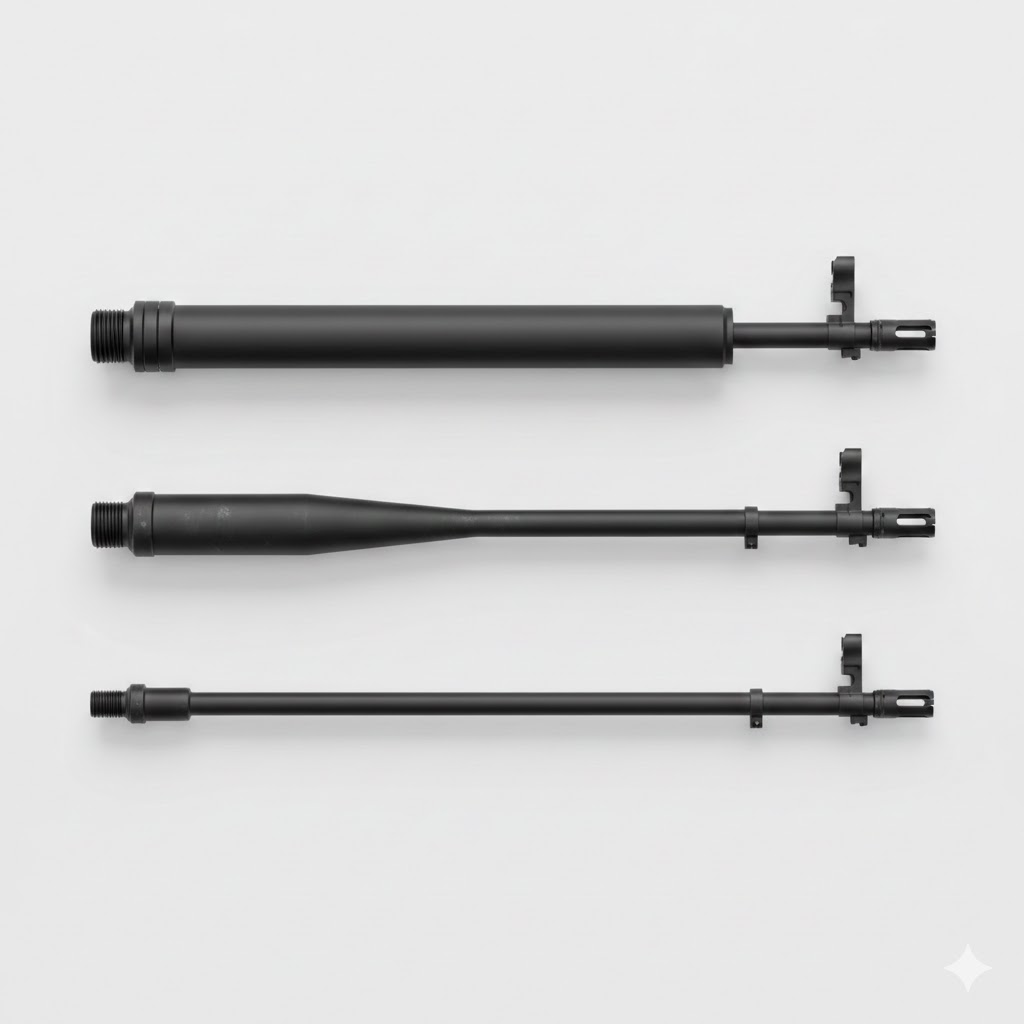
Choosing a Barrel: Length, Profile, and Twist Rate
What This Article Covers
This guide explains the three barrel decisions that most shape how an AR-15 feels and performs: length, profile, and twist rate. It focuses on tradeoffs like velocity vs. handling, weight vs. heat management, and bullet stability vs. versatility. The goal is to clarify the choices, not recommend a single setup.
Key takeaways
- Longer barrels usually add velocity and stability, while shorter barrels are easier to handle.
- Heavier profiles resist heat and flex but add forward weight.
- Twist rate must match the bullet weight range you plan to shoot.
- There is no best barrel, only the best match for your use case.
Barrel Length: Velocity vs. Handling
Barrel length affects two big things: how much velocity you get from a given cartridge and how the rifle handles. Longer barrels generally increase velocity and reduce muzzle blast. Shorter barrels are lighter and faster to maneuver, but give up some velocity and can be louder or sharper in recoil.
Velocity and Effective Range
More length usually means more muzzle velocity Muzzle velocity: the speed of the bullet as it leaves the barrel., but the gains are not linear. Each additional inch adds less velocity than the one before it. For most builds, the practical question is whether the added length helps you reach your typical distances with more consistency, not whether it produces the maximum possible speed.
Common lengths you will see:
- 10.3-11.5 inches: Very compact and maneuverable, often used where size is the priority. Expect more blast and less velocity.
- 14.5 inches: A popular balance point with good handling, often paired with a pinned muzzle device to meet legal length.
- 16 inches: The most common civilian length, offering versatility with no pinning required.
- 18 inches: Often used for mid-range precision or competition, with a bit more velocity than 16.
- 20 inches: Traditional rifle length with maximum velocity for 5.56 and softer gas dynamics.
Length does not exist in a vacuum. Gas system length, suppressor use, and intended shooting distances all interact with it.
Use-Case Snapshots for Length
- General-purpose: 14.5-16 inches is common for balancing handling and velocity.
- Competition: 16-18 inches can help with recoil control and velocity for longer stages.
- Hunting: 16-20 inches is often chosen to maximize effective range and terminal performance.
- Compact / vehicle use: 10.3-12.5 inches is popular for short, easy-to-store setups, with more blast and lower velocity as the tradeoff.
Legal Considerations (High Level)
Barrel length can carry legal implications depending on where you live. In the U.S., barrels under 16 inches on a rifle typically fall under NFA SBR rules, while pistol configurations have different requirements. Some builders use a pinned and welded muzzle device on a 14.5-inch barrel to reach a legal 16-inch overall barrel length. This is not legal advice; verify your local laws and current federal guidance before committing to a configuration.
Barrel Profile: Weight, Balance, and Heat
The barrel profile is the contour and thickness of the steel along its length. It affects how heavy the rifle feels, where the balance point sits, and how the barrel handles heat.
Common profiles include:
- Pencil / Lightweight: Minimal weight and fast handling, but heats up quickly.
- Government: A common mid-weight profile with a thinner section under the handguard.
- HBAR / Heavy: More mass to resist heat and flex, but adds noticeable forward weight.
- SOCOM / Medium-heavy: A heavier contour near the chamber and gas block, often used for durability.
Heavier profiles can help maintain consistency during long strings of fire because heat has less effect on barrel flex. Lighter profiles are easier to carry and transition but can warm up faster.
Balance and Handling
Barrel profile changes how a rifle carries and transitions. A heavy profile shifts the balance forward, which can feel steadier in slow fire but slower when moving between targets. A lighter profile keeps the rifle lively but can feel less planted on long strings. This is why two barrels with the same length can feel very different in the hands.
How Heat Shows Up in Real Use
Heat is not just a comfort issue. As barrels heat, point of impact can drift slightly and the rifle may feel less predictable. For a casual range session, this may not matter. For a long string of fire or a timed stage, a heavier profile can buy more consistency before heat becomes noticeable. The tradeoff is always front-end weight.
Twist Rate: Matching Bullet Weight to Stability
Twist rate Twist rate describes how fast the barrel spins the bullet, expressed as one full rotation per X inches (for example, 1:7). A 'faster' twist has a smaller number. determines how well different bullet weights stabilize in flight. A faster twist (e.g., 1:7) spins the bullet more, which is necessary to stabilize longer, heavier bullets. A slower twist (e.g., 1:9) is often adequate for shorter, lighter bullets.Common AR-15 twist rates:
- 1:7: Stabilizes heavier bullets well, often used for 62-77 grain loads.
- 1:8: A versatile middle ground that handles a wide range of bullet weights.
- 1:9: Usually works best with lighter bullets, like 55 grain and below.
The goal is stable, consistent flight across the ammunition you plan to use. Over-stabilization is rarely a practical problem, but under-stabilization can cause poor accuracy or keyholing.
Bullet Weight Ranges in Practice
If you primarily shoot 55-grain training ammo, a 1:9 or 1:8 twist is usually fine. If you plan to run heavier 69-77 grain match loads, 1:7 or 1:8 is the safer bet. The farther you shoot, the more stability matters. If you are unsure, a 1:8 twist generally covers the widest range.
Twist Rate vs. Bullet Length
Bullet length matters as much as bullet weight. Longer bullets need more spin to stabilize, which is why heavier match loads often prefer faster twist rates. If you plan to shoot a mix of short training bullets and longer precision loads, favoring a faster twist is usually the safer compromise.
How These Choices Work Together
Length, profile, and twist rate are connected. For example:
- A short barrel with a heavy profile may balance similarly to a longer barrel with a lightweight profile.
- A longer barrel can make velocity more forgiving with lighter bullets, but twist rate still matters.
- Heat and accuracy concerns are more noticeable during long strings of fire or competition use.
Think of the barrel as a system decision. Your use case should drive the tradeoffs, not a single spec.
Suppressed Use: What Changes
Suppressors add length and weight at the muzzle. A short barrel can feel more balanced once a suppressor is installed, while a long barrel plus suppressor can feel front-heavy. Suppressors also increase back pressure, which can make the rifle feel more overgassed. That often pushes builders toward gas tuning solutions rather than barrel changes, but it is still part of the overall planning. See our article on muzzle devices for suppressors for more on this topic, and our buffer system guide for how buffer weight and spring selection help manage increased gas pressure in suppressed setups.
Decoding Common Barrel Specs
When reading a barrel listing, you will often see:
- Chamber: 5.56 NATO, .223 Wylde, or .223 Rem. The chamber Chamber: the part of the barrel that holds the cartridge before firing. Chamber dimensions affect pressure and ammo compatibility. affects pressure tolerance and ammo flexibility.
- Material: 4150 CMV, 4140, or stainless. Materials impact durability and corrosion resistance.
- Finish: Nitride, chrome lining, or bare stainless. Finishes trade off corrosion resistance, barrel life, and cost.
- Gas system length: Carbine, mid, or rifle. This affects recoil impulse and suppression behavior. See our guide to AR-15 Gas Systems for more detail.
These specs do not define quality alone, but they help set expectations for longevity and use case.
Choosing a Barrel: Factors to Consider
Key questions that help narrow the choice:
- What is your typical shooting distance?
- Are you prioritizing portability or stability?
- Will you shoot high-volume strings where heat matters?
- What bullet weights are you most likely to use?
- Do you plan to run suppressed regularly?
There is no universal answer. Many builders start with a general-purpose setup and refine from there as their use case becomes clear.
Common Misunderstandings
- “Longer is always better.” Longer adds velocity but can be slower to handle.
- “Heavy barrels are always more accurate.” Weight helps with heat and rigidity, but manufacturing quality matters more.
- “Any twist rate works with any ammo.” Twist rate still needs to match bullet length and weight for stability.
Quick Decision Checklist
If you are unsure, this quick checklist helps:
- Pick a length that matches your typical distance and handling needs.
- Choose a profile you can comfortably carry for your expected firing pace.
- Select a twist rate that covers the bullet weights you plan to use.
- Use the remaining specs to confirm durability and compatibility.
Related Tool
Related Tool
Barrel Velocity Estimator
Estimate likely muzzle velocity ranges by caliber family and barrel-length bucket. Share the exact calculator state with a URL.
Estimate muzzle velocity range