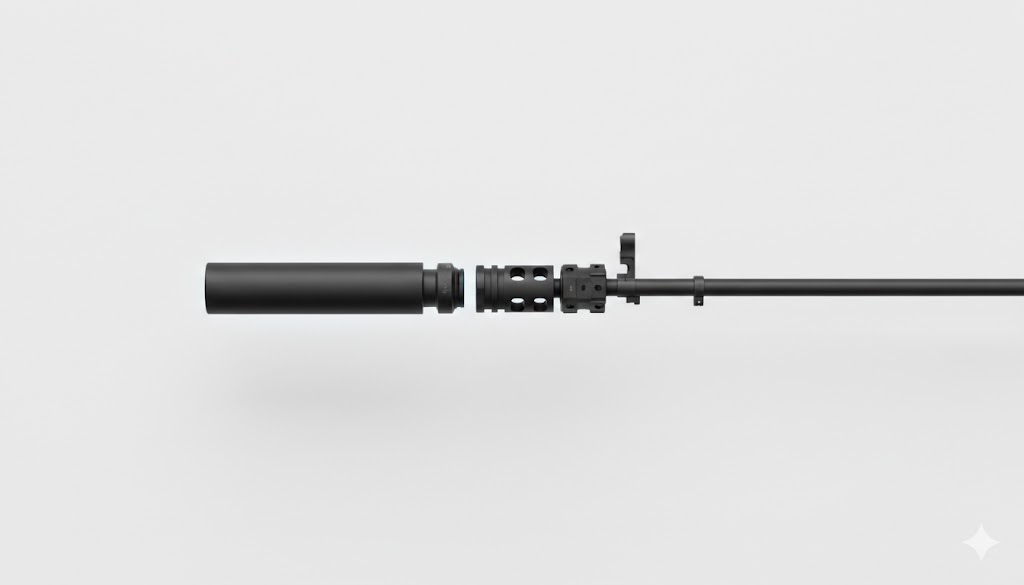
Muzzle Device Selection for Suppressor Hosts
What This Article Covers
This guide explains how muzzle device selection changes when a rifle will host a suppressor. It covers common thread pitch standards, the main mount system types (direct-thread, QD, taper mounts), alignment and timing concerns, and the practical effects on back pressure and point-of-impact shift. The goal is to clarify tradeoffs and system interactions, not to recommend specific products.
Key takeaways
- Thread pitch and shoulder quality determine compatibility and alignment.
- QD adds convenience and repeatability, while direct-thread stays simple and light.
- Mount design can affect back pressure, durability, and POI consistency.
- Alignment checks are critical to prevent baffle strikes.
Thread Pitch Standards for AR-15s
Most AR-15 barrels use 1/2x28 TPI Threads per inch: the number of thread peaks per inch of barrel threading. for .223/5.56, while larger bore cartridges like .300 BLK commonly use 5/8x24 TPI. Thread pitch must match between the barrel, any muzzle device, and the suppressor or mount. Many barrels ship with a thread protector installed, which must be removed before installing a device. The thread pitch is the starting point for compatibility, but the shoulder behind the threads and overall concentricity Concentricity is how well the suppressor bore and barrel bore share the same centerline. matter just as much for alignment.
Mount System Types: An Overview
Direct-Thread Suppressors
Direct-thread is the simplest interface: the suppressor threads directly onto the barrel (or a dedicated threaded adapter). The main advantages are fewer parts, lower weight, and a straightforward setup. The tradeoffs are slower on/off, potential for carbon lock Carbon lock: carbon fouling that binds a suppressor or mount, making removal difficult. if the suppressor is run hot, and less convenience if you move a suppressor between hosts. Direct-thread remains common for dedicated hosts where the suppressor stays installed most of the time.
Quick-Detach (QD) Mount Systems
QD systems use a separate muzzle device that stays on the barrel and provides a standardized interface for the suppressor to attach and detach quickly. The advantages are speed, repeatability, and easier use across multiple rifles. The tradeoffs include added weight, added cost (each host needs a compatible mount), and additional tolerance stack-up that can affect point of impact. QD is popular for builders who move a suppressor between multiple hosts.
Taper-Mount Interfaces
Taper mounts use a precision-machined conical interface for alignment and lockup. The suppressor slides onto a tapered muzzle device and is secured by a collar or lock mechanism. The taper centers the suppressor and can improve repeatability by reducing wobble. The tradeoffs are cost and the need for precise machining on both the mount and suppressor. These systems are often chosen when consistency and alignment are prioritized over universal compatibility.
Muzzle Device as Sacrificial Baffle
Some QD mounts are designed to act as a sacrificial blast baffle or blast chamber. In these designs, the first high-pressure gas and particle impact is absorbed by the mount rather than the suppressor itself. This matters because mounts are relatively easy to replace if they erode, and the extra volume can help with first-round flash. Not all mounts serve this function; some are purely an attachment interface with minimal internal volume.
Alignment: Why It Matters
Suppressor alignment is critical. Because the AR-15 platform operates with high pressures and tight tolerances, there is very little room for error. If the bore and suppressor are not concentric, the projectile can contact internal baffles (a baffle strike Baffle strike: when a bullet contacts the suppressor's internal baffles, damaging the suppressor and creating a safety risk.), which damages the suppressor and creates a safety hazard. Misalignment usually comes from one of three sources: barrel threads that are cut off-axis or damaged, a muzzle device installed crooked or over debris, or tolerance stacking between the mount and the suppressor. Alignment rods exist to verify concentricity before live fire, and they are a good safeguard when setting up a new host.
Shoulder vs. Taper Alignment
Most mounts index off the barrel shoulder, while taper mounts use a conical surface to self-center. Both can be reliable when machined correctly, but each depends on clean, square mating surfaces. If the shoulder is uneven or the taper is damaged, alignment suffers.
Thread Timing and Crush Washers
Some muzzle devices (flash hiders, comps, brakes) have directional ports and must be timed so the vents face the correct direction. Common timing methods include crush washers, peel washers or shim kits, and high-temperature threadlocker for a more permanent install. Suppressor mounts that are cylindrical often do not require timing, but some QD mounts do. If a device needs timing, shims typically provide more consistent alignment than a deformed crush washer. Improper timing does not usually affect suppressed function, but it can affect unsuppressed blast direction and performance.
Back Pressure and Gas System Considerations
Suppressors increase back pressure, which drives more gas into the action. This can lead to overgassing symptoms like harsher recoil, faster ejection, and accelerated wear. Muzzle device design plays a role here: some QD mounts include features that vent gas or add volume, while direct-thread interfaces are typically simpler with less venting. Flow-through suppressors can reduce back pressure overall, but the mount still influences how the system behaves. This is a system-level decision that also touches gas system length and adjustable gas blocks, not just the muzzle device alone.
Point-of-Impact (POI) Shift
Adding a suppressor often shifts point of impact due to increased mass at the muzzle, barrel harmonics, and the geometric alignment of the suppressor to the bore. Back pressure can also influence timing and harmonics. The key concern is repeatability: a QD mount should return to the same POI Point of impact: where the rounds land on target relative to your point of aim. after removal and reattachment. Some taper systems aim for minimal shift, but no interface guarantees zero change. A small, consistent shift is usually manageable once the shooter confirms the offset.
Choosing a Mount System: Factors to Consider
Considerations that usually matter most:
- Single host vs. multi-gun: QD systems simplify moving a suppressor across hosts; direct-thread is fine for a dedicated setup.
- Frequency of removal: QD favors frequent on/off use; direct-thread favors long-term installation.
- Budget: direct-thread is generally lower cost, while QD adds the price of mounts for each host.
- Precision requirements: taper systems emphasize alignment and repeatability; traditional QD remains common for general use.
- Suppressor compatibility: not all suppressors accept all mounts, so verify the intended interface first.
There is no universal best choice. The right system depends on how the rifle will be used and how much flexibility you need.
Barrel Length and Suppressor Considerations
Barrel length affects how a suppressor behaves. Shorter barrels produce higher muzzle pressure and more blast, which can increase back pressure and make suppression feel more aggressive. Longer barrels allow more complete powder burn and generally reduce flash and pressure at the muzzle. Very short barrels can be harsh even when suppressed. This ties back to system-level tuning: the muzzle device, suppressor, gas system, and barrel length work together.
Common Misunderstandings
Some common misconceptions:
- “QD mounts always shift POI significantly.” Most modern systems are repeatable, even if a small, consistent shift exists.
- “Direct-thread is obsolete.” It remains a valid choice for dedicated hosts.
- “Taper mounts eliminate POI shift entirely.” They can reduce shift, not eliminate it.
- “Any muzzle device works with any suppressor.” Compatibility and alignment must be verified.
Installation Best Practices
General installation guidance:
- Clean barrel threads and shoulder surfaces thoroughly.
- Inspect for damage or debris that could cant the device.
- Hand-start the device to avoid cross-threading.
- Use the manufacturer torque spec (often in the 20-30 ft-lb range, but verify).
- Check alignment with a rod before live fire, especially on a new host.
- Use a high-temperature threadlocker like Rocksett if a more permanent install is desired; standard threadlockers can fail under heat.
Always follow the manufacturer instructions for the specific device and suppressor mount.
Maintenance and Wear
Mounts are wear items. Carbon buildup, heat cycles, and repeated removal can change how smoothly a suppressor locks up. Periodic cleaning of threads and mounting surfaces helps maintain repeatability and reduces the chance of the suppressor backing off under fire.
Related Tool
Related Tool
Sound / Hearing Risk Estimator
Estimate broad peak dB ranges with environment and muzzle setup inputs, then share the same state by URL for comparison discussions.
Estimate sound range