Handguard & Rail Systems: M-LOK, Picatinny, and Free-Float vs. Drop-In
What This Article Covers
This guide explains the main handguard and rail options for AR-15s. It compares M-LOK and Picatinny attachment standards, explains free-float versus drop-in designs, and highlights how these choices affect ergonomics, accessory mounting, and potential accuracy.
Key takeaways
- M-LOK is lighter and smoother, while Picatinny is universal and rugged.
- Free-float handguards can improve consistency by isolating the barrel.
- Drop-in handguards are simple to install and use standard delta rings.
- Ergonomics and accessory needs should drive the choice.
The Two Decisions That Matter
Handguard selection boils down to two main choices:
- Which attachment standard you want for accessories.
- Whether you want a free-float or drop-in handguard design.
Understanding those two decisions will cover most of what new builders need to know.
M-LOK vs. Picatinny
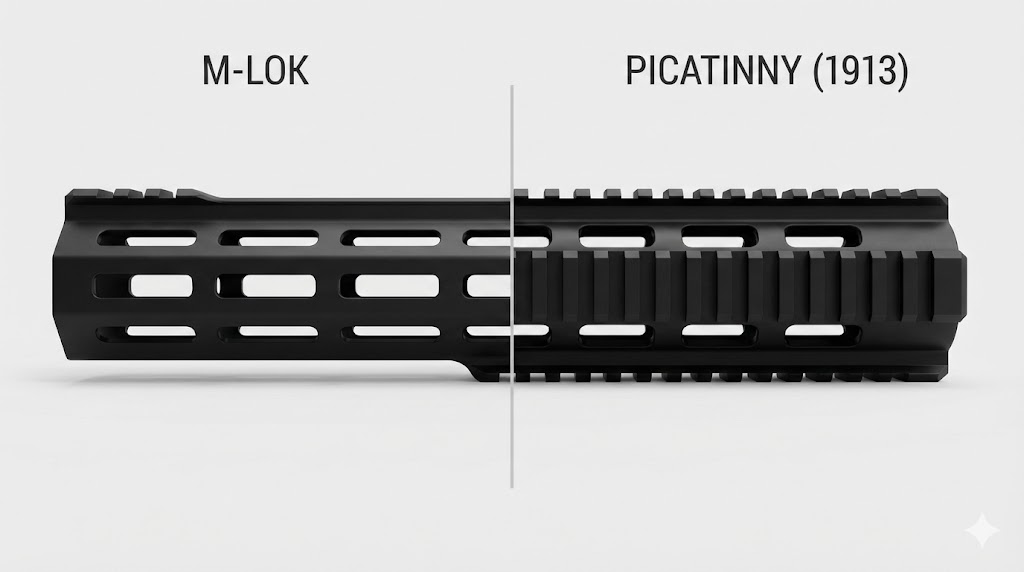
Picatinny (1913) is the older, universal rail standard. It uses a series of square slots that accept a wide range of accessories.
M-LOK uses elongated slots and T-nuts to mount accessories directly to the handguard.
Picatinny strengths
- Wide compatibility with legacy accessories.
- Extremely durable mounting interface.
- Easier for quick on/off without repositioning.
Picatinny tradeoffs
- Adds weight and bulk.
- Can feel sharp without rail covers.
M-LOK strengths
- Lighter and slimmer overall profile.
- Smoother grip surface.
- Common on modern handguards and accessories.
M-LOK tradeoffs
- Requires specific M-LOK accessories or rail sections.
- Slightly more involved installation (alignment and torque).
In practice, many handguards use M-LOK with small Picatinny sections at the top or front to support optics, lights, or lasers.
Keymod: While M-LOK and Picatinny are the dominant standards, some older handguards use Keymod. Keymod was an earlier attempt at a lightweight, direct-attachment system, similar to M-LOK. While it had its proponents, M-LOK largely superseded Keymod due to better performance in testing and broader industry adoption. If you encounter a Keymod handguard, be aware that accessories specifically designed for Keymod will be required, and they are less common than M-LOK options today.
Use-Case Snapshots
- General-purpose: M-LOK rails with a short Picatinny section for a light cover most needs.
- Duty / defensive: Full-length Picatinny or hybrid rails keep compatibility broad and accessories secure.
- Competition: M-LOK favors lighter builds and flexible accessory placement.
- Range / recreation: Either system works; choose based on accessory plans and budget.
Free-Float vs. Drop-In
Free-Float Handguards
Free-float handguards attach to the upper receiver with a dedicated barrel nut Barrel nut: the threaded nut that secures the barrel to the upper receiver and often serves as the mounting surface for a free-float handguard. and do not contact the barrel. This free-float Free-float: a handguard design that does not touch the barrel, preventing external pressure from influencing barrel movement. design prevents handguard pressure or sling tension from influencing the barrel, which can improve consistency.
Benefits
- More consistent accuracy potential.
- More mounting space for accessories.
- Often lighter and more rigid.
Tradeoffs
- Requires more involved installation.
- Usually needs tools and torque specs.
- May require removing the front sight base on older builds.
Drop-In Handguards
Drop-in handguards fit into the existing delta ring and handguard cap, and they contact the barrel assembly.
Benefits
- Simple installation with minimal tools.
- Works with traditional front sight bases.
- Good for basic or retro-style builds.
Tradeoffs
- Less rigid and less consistent under pressure.
- Limited mounting space compared to modern free-float rails.
For most modern builds, free-float is the common choice. Drop-in remains useful for simplicity and compatibility with classic setups.
Gas Block Clearance
Free-float handguards vary in internal diameter. If your build uses a larger or adjustable gas block, confirm the handguard has enough clearance. This matters most on slim rails, where internal space can be tight.
Rail Height and Top Rail Choices
Most modern free-float handguards align the top rail with the upper receiver for a continuous optics rail. Some designs use a lower top rail height to reduce bulk, but that can limit top-mounted accessories or require special mounts. If you plan to run a front sight, laser, or extended optic setup, confirm the rail height and continuity before choosing.
Length, Weight, and Heat
Longer handguards provide more grip area and accessory placement, but they add weight. Shorter handguards are lighter and faster to handle but reduce mounting real estate. Heat management also matters: slim rails heat up faster than thicker profiles, and metal handguards transmit heat directly to the hand.
If you expect long strings of fire, consider how you will manage heat with gloves or rail covers.
Attachment, Alignment, and Torque
Free-float handguards attach to a proprietary barrel nut and typically use anti-rotation tabs or clamp systems to keep the rail aligned. Proper torque and alignment matter because the handguard can affect sights, lasers, or point-of-impact consistency if it shifts. Installation requirements vary by brand, so follow the manufacturer torque spec and confirm the handguard is aligned with the upper receiver.
A Note on Materials
Most free-float handguards are made from aluminum, which offers a good balance of strength, weight, and heat dissipation. It is rigid and durable, making it the standard for most builds. Polymer handguards, common in drop-in designs, are typically lighter and better insulators against heat, but are often less rigid than their aluminum counterparts.
Sling Mounting and QD Sockets
Many modern handguards include integrated QD sockets QD (quick-detach) socket: a reinforced sling attachment point that accepts a push-button swivel. for sling attachments, while others require add-on mounts. If you plan to run a sling, check whether the handguard has reinforced QD points and whether they are placed where you want them for carrying or stability.
Accessory Placement and Ergonomics
Handguards change how the rifle feels in the hands. A slimmer profile supports a modern extended grip, while a bulkier rail may feel more stable with a classic grip. Your accessory plan matters here: lights, grips, and bipods need space and affect balance.
This is where the “feel” of a handguard can matter as much as its technical specs.
Suppressed Use and Muzzle Clearance
If you plan to run a suppressor, check the handguard length relative to the muzzle device. Some builders prefer a shorter rail to keep the suppressor clear of the handguard and to avoid excessive heat transfer. Others use longer rails to extend grip length, but this can bring your support hand closer to the hottest part of the system. For details on suppressor mounting interfaces, thread pitch, and alignment, see our guide to muzzle devices for suppressors.
Recessed Suppressors and Inner Diameter
Some handguards have a larger inner diameter that allows a suppressor to tuck under the rail. If that is your plan, confirm the handguard’s inner diameter and the suppressor’s outer diameter, plus clearance for mounting. Recessed setups can change heat management and may limit accessory placement near the front.
Common Misunderstandings
- “Free-float makes any rifle accurate.” It improves consistency but does not replace barrel or ammo quality.
- “M-LOK is always better.” It is lighter, but Picatinny remains more universal.
- “Drop-in is outdated.” It is still useful for simplicity and classic builds.
Choosing a Handguard
When deciding, consider:
- How many accessories you plan to mount.
- Whether you want a slim grip or a rail-heavy profile.
- How important precision consistency is to your build.
- Whether you want a simple install or are comfortable with a more involved setup.
The right choice is the one that supports how you actually use the rifle.
Quick Decision Checklist
If you are unsure, this quick checklist helps:
- Choose free-float for modern builds and drop-in for simplicity or retro setups.
- Pick M-LOK for lighter, slimmer rails or Picatinny for maximum compatibility.
- Match handguard length to your grip style and accessory plan.
- Confirm rail height, alignment method, and sling attachment options.