The AR-15 Buffer System Explained
What This Article Covers
This guide explains the AR-15 buffer system and how it influences cycling, recoil feel, and reliability. It covers receiver extension types, buffer weights, spring behavior, and how builders tune the system for different gas setups or suppression.
Key takeaways
- Buffer systems balance reliability, recoil feel, and bolt speed.
- Carbine and rifle extensions are not interchangeable without matching parts.
- Heavier buffers slow the action and can reduce overgassing.
- Suppressed rifles often benefit from additional buffer mass.
What the Buffer System Does
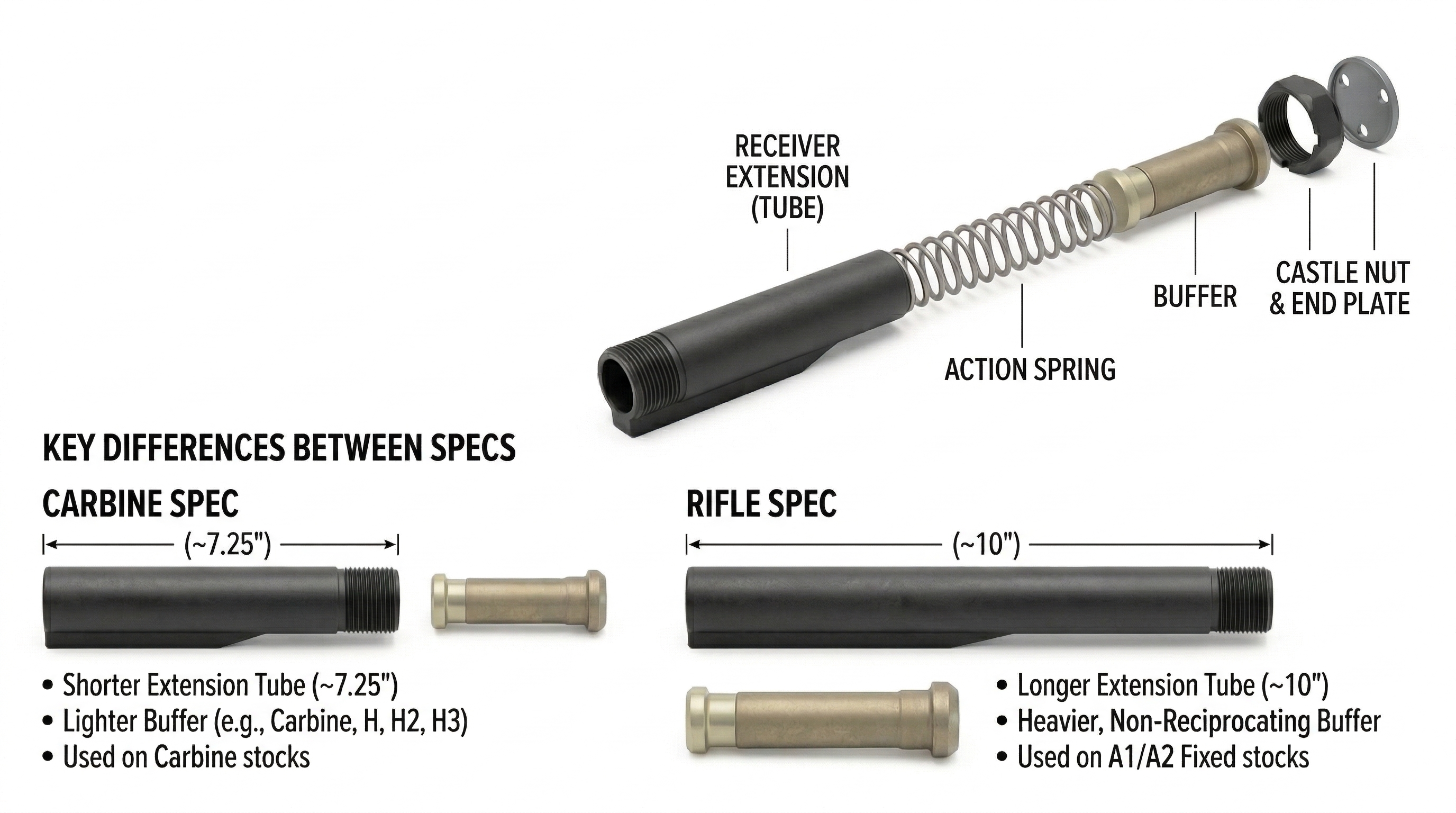
The buffer system sits in the stock assembly and controls how the bolt carrier group moves after firing. The buffer Buffer: the weighted cylinder that rides in the receiver extension and slows the bolt carrier as it cycles. and action spring absorb energy, slow the carrier, and return it forward to chamber the next round. It is the other half of the gas system: gas drives the action, the buffer system resists and returns it.
Buffer Components at a Glance
The buffer system is simple, but the parts work as a set:
- Buffer body and weights: mass that slows the carrier and shapes recoil.
- Action spring: returns the carrier forward and controls bolt speed.
- Receiver extension: the tube that determines spring length and travel.
Changing one part affects the others, so compatibility matters.
Carbine vs. Rifle Receiver Extensions
The receiver extension Receiver extension (buffer tube): the tube that houses the buffer and spring and provides the mounting point for the stock. comes in two main lengths:
- Carbine extensions are shorter and used with collapsible stocks.
- Rifle extensions are longer and used with fixed stocks.
These two systems use different buffer lengths and springs. Mixing them can cause reliability issues because the travel distance and spring length are designed as a set.
Intermediate-Length Systems
Some builds use intermediate-length receiver extensions that sit between carbine and rifle lengths. These systems aim to smooth recoil by increasing spring length and travel, but they require matching buffers and springs. If you encounter one, treat it as its own ecosystem rather than mixing parts across systems.
Buffer Weights: Carbine, H, H2, H3
Carbine buffers are the lightest. Heavier buffers (H, H2, H3) add mass to slow the carrier’s rearward speed. More weight generally means:
- Reduced bolt velocity.
- Softer recoil impulse.
- Less violent ejection.
Heavier is not always better. Too much mass can cause short-stroking if the gas system does not provide enough energy.
Typical Weight Ranges
Exact weights vary by manufacturer, but common ballparks are:
- Carbine: ~3.0 oz
- H: ~3.8 oz
- H2: ~4.6 oz
- H3: ~5.4 oz
These numbers are just reference points. The best weight is the one that keeps the rifle reliable with your ammo and gas setup.
Buffer Weight and Ammo
Buffer weight choices should consider the ammunition you actually shoot. Lower-pressure loads can struggle with very heavy buffers, while hotter loads can feel harsh with light buffers. If reliability varies with ammo, buffer weight is one of the first tuning levers to adjust.
Springs and Their Effect
The action spring Action spring: the spring in the receiver extension that returns the bolt carrier forward after a shot. determines how quickly the carrier returns forward and how much resistance it provides. Worn or weak springs can lead to inconsistent cycling. Stronger springs can tame overgassing but may increase the force required to cycle manually.
Spring choice usually follows the extension type (carbine vs. rifle) and the buffer weight used.
Tuning for Suppressed Use
Suppressors increase back pressure and drive the action harder. This can make a rifle feel overgassed. Heavier buffers, stronger springs, or adjustable gas systems are common ways to bring bolt speed back under control.
The goal is a balanced cycle: reliable ejection and feeding without excessive recoil or parts wear.
For more on the gas side of the equation, see Understanding AR-15 Gas Systems.
Signs of Imbalance
Common indicators that the buffer system is too light or too heavy:
- Too light: harsh recoil, ejection forward of 3 o’clock, excessive wear.
- Too heavy: weak ejection, failures to lock back, short-stroking.
Ejection pattern is only one clue. The overall feel and reliability matter more than any single indicator.
A Simple Tuning Order
If the rifle feels overgassed or sluggish, start with the simplest changes:
- Confirm the correct buffer and spring for your receiver extension.
- Adjust buffer weight before changing multiple parts at once.
- If suppression is involved, consider adjustable gas or heavier buffers as a matched solution.
Bolt Bounce and Lockup
When the carrier returns forward, it can rebound slightly off the barrel extension. Heavier buffers and stronger springs can reduce this bolt bounce Bolt bounce: a brief rebound of the bolt carrier after it closes, which can affect reliability in rare cases., but too much resistance can also slow the system down. If you see inconsistent lock-back or feel sluggish cycling, balance is likely the issue.
Common Misunderstandings
- “Heavier is always better.” Too much weight can cause reliability problems.
- “Any buffer fits any tube.” Carbine and rifle systems require matched parts.
- “The buffer system is optional for tuning.” It is one of the primary tuning tools.
Choosing a Buffer Setup
Start with the buffer weight recommended for your barrel and gas system. If the rifle is overgassed or suppressed, heavier buffers can help. If reliability suffers, step back toward the standard weight.
The most reliable setup is the one that cycles consistently across your ammo and use case.