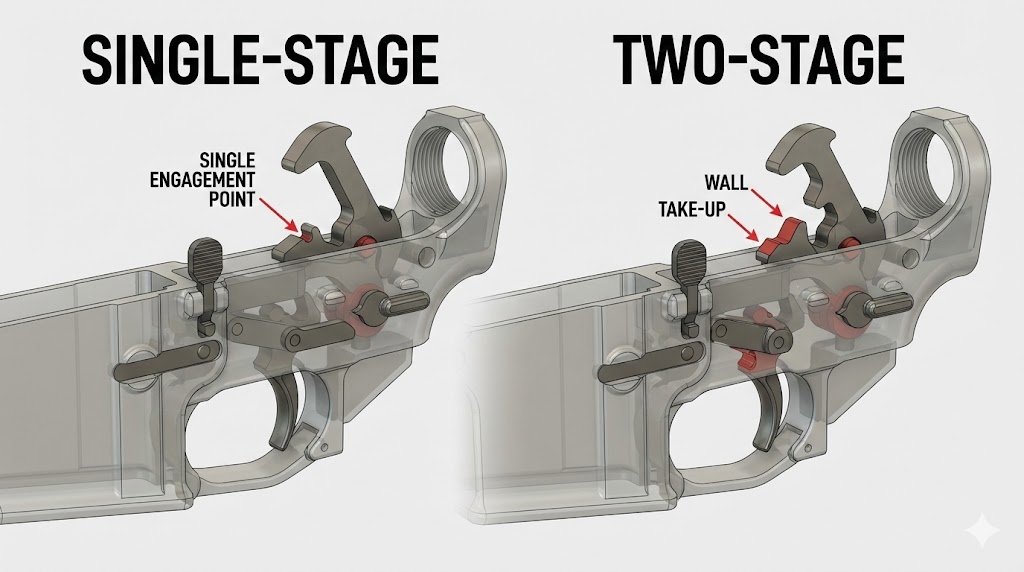
Trigger Selection: Single-Stage vs. Two-Stage
What This Article Covers
This guide explains how single-stage and two-stage triggers feel and function on an AR-15. It covers pull weight, reset, shoe shape, and how those factors affect control and consistency. The goal is to clarify tradeoffs, not to recommend a specific trigger.
Key takeaways
- Single-stage triggers break with one continuous press.
- Two-stage triggers add a defined first stage before the break.
- Pull weight and reset shape how fast and predictable a trigger feels.
- Ergonomics (shoe shape) matter as much as raw weight.
The Role of the Trigger
The trigger is the primary control surface of the rifle. A good trigger does not make a rifle accurate, but it makes it easier to shoot consistently. The choice mostly changes how the break feels and how repeatable the press is under speed or precision demands.
Common Trigger Feel Terms
- Take-up: Take-up is the initial movement before the trigger meets resistance.
- Wall: The point where resistance increases and the trigger is ready to break.
- Break: Break is the actual release point.
- Reset: Reset is how far the trigger returns before it can fire again.
Single-Stage Triggers
A single-stage trigger has one smooth press that ends at the break. There is no defined “take-up.” The press is continuous until the sear releases.
Strengths
- Simple and predictable under speed.
- Often feels faster for rapid strings.
- Common on duty or general-purpose rifles.
Tradeoffs
- Less pre-travel to “stage” the shot.
- Some shooters feel less control for slow, precise presses.
Two-Stage Triggers
A two-stage trigger has a light first stage that ends at a defined wall, followed by a second stage that breaks. The shooter can take up the first stage and then press through the second stage when ready.
Strengths
- Easier to prep the shot for precision.
- Clear wall can reduce over-travel in slow fire.
- Common on precision and competition rifles.
Tradeoffs
- Can feel slower for high-speed firing.
- Requires consistent technique to avoid riding the wall.
Why Two Stages for Precision?
The two-stage design allows a shooter to “prep” the trigger. By taking up the first stage and pausing at the wall, you can confirm your sight picture and stabilize your position before committing to the final, clean break of the second stage. This separation helps reduce the chance of disturbing the sights during the most critical moment of the press, which is why it’s favored for precision work.
Pull Weight: What the Numbers Mean
Pull weight is the force required to break the trigger. Manufacturers may list total pull weight or the combined stages for two-stage triggers. Lower weights can feel lighter and faster but may be less forgiving under stress or rough handling. Higher weights can feel safer and more deliberate but may reduce precision for some shooters.
There is no universal best weight. The right range depends on use case, training, and how much mechanical margin you want.
Trigger Reset and Speed
Reset is the distance the trigger must travel forward to re-engage after firing. A short, tactile reset supports faster follow-up shots. A longer reset can feel slower but may reduce unintentional rapid fire for inexperienced shooters.
Reset feel varies by design. Some triggers are crisp and loud; others are softer and less distinct. Neither is automatically better, but it changes how the trigger feels during rapid strings.
Trigger Shoe Shape and Ergonomics
Trigger shoes are typically curved or flat:
- Curved shoes center the finger and are familiar to most shooters.
- Flat shoes can encourage a consistent finger position and a straight-back press.
Neither shape is universally superior. The more important factor is whether the shoe allows you to press straight to the rear without lateral pressure, which can move the sights.
Installation: Drop-In vs. Cassette Triggers
Aftermarket triggers come in two main installation styles:
- Component Triggers: These are the traditional style, where the trigger, hammer, and disconnector are installed as individual parts held in the lower receiver by pins. They are highly compatible but can be slightly more complex to install.
- Cassette Triggers: These triggers house all components in a self-contained aluminum housing that “drops in” as a single unit. They are simpler to install but can sometimes have a less secure fit or compatibility issues with receivers that are not machined to standard dimensions.
Match vs. Duty Considerations
Competition and precision shooters often prioritize a clean break and a crisp wall. Duty or general-purpose rifles may prioritize reliability, safety margin, and consistency under stress. The same trigger can feel different depending on the rifle’s role and how the shooter trains.
Reliability and Ignition
Trigger feel is not the only variable. Hammer spring weight and sear geometry affect primer ignition reliability. Very light setups can reduce pull weight but may be more sensitive to hard primers or rough conditions. If the rifle is intended for duty or defensive use, reliability and safety margin usually outweigh the lightest possible pull.
Common Misunderstandings
- “Two-stage triggers are always more accurate.” Accuracy comes from the shooter and the rifle; the trigger just makes consistency easier.
- “Single-stage is only for speed.” Single-stage triggers can be very precise with good technique.
- “Lightest pull weight is best.” Too light can be a liability in dynamic shooting or under stress.
Choosing Between Them
A simple way to decide is to consider how you shoot:
- If you value speed and simplicity, a single-stage may feel more natural.
- If you want a defined prep point for precision, two-stage may feel more controlled.
- If you shoot both styles, try to match the trigger to your dominant use case.
The best trigger is the one you can control predictably and safely.