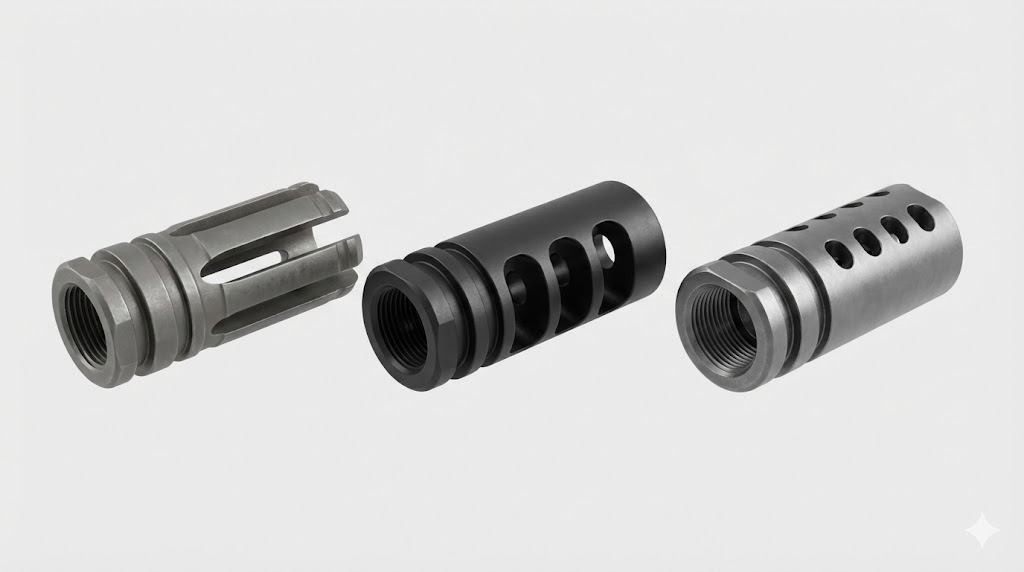
Muzzle Devices: Flash Hiders, Compensators, and Brakes
What This Article Covers
This guide explains the three main muzzle device types on AR-15s: flash hiders, compensators, and brakes. It focuses on what each device is designed to do and the practical tradeoffs in recoil control, flash reduction, and shooter comfort.
Key takeaways
- Flash hiders reduce visible flash but do not reduce recoil much.
- Brakes reduce recoil but increase blast and side concussion.
- Compensators reduce muzzle rise, especially in rapid fire.
- Hybrid devices try to balance these tradeoffs, but none eliminate them.
- Barrel length and ammo choice change how aggressive a device feels.
- The best choice depends on where and how you shoot.
Why Muzzle Devices Matter
The muzzle is where high-pressure gas exits the barrel. A muzzle device shapes how that gas vents, which changes felt recoil, muzzle rise, and flash signature. Every design is a tradeoff between control and blast.
Recoil vs. Muzzle Rise
Recoil is the rearward push into the shoulder. Muzzle rise is the upward rotation of the barrel after the shot. Brakes are more focused on reducing rearward recoil, while compensators are tuned to push the muzzle down. Many devices do both, but which effect is emphasized depends on port size and placement.
If you shoot fast strings, muzzle rise control can matter more than raw recoil reduction. If you shoot heavier calibers or longer strings, reducing rearward push can feel more helpful.
Flash Hiders
Flash hiders disperse and cool hot gases to reduce the visible muzzle flash. They are designed to protect the shooter’s night vision and reduce signature in low light.
Strengths
- Best flash reduction.
- Generally lower concussion than brakes.
- Often lighter and simpler.
Tradeoffs
- Minimal recoil reduction.
- Limited control of muzzle rise.
Flash hiders are common on general-purpose and duty rifles where low-light flash matters.
Open vs. Closed Tine
Some flash hiders use open tines to disperse gas, while others use a closed bottom to reduce dust kick-up when shooting prone. The differences are subtle, but if you shoot prone on dirt or in low light, the bottom design can affect how much dust and flash you see.
Compensators
Compensators vent gas upward or to the sides to counter muzzle rise. They help keep the dot or reticle flatter during rapid strings.
Strengths
- Good muzzle rise control.
- Useful for fast follow-up shots.
- Often used in competition.
Tradeoffs
- Increased side blast and noise.
- Flash reduction is limited.
Compensators are often tuned for speed on the range, but they can be unpleasant on crowded firing lines.
Muzzle Brakes
Brakes redirect gas to the sides and sometimes slightly rearward. This reduces rearward recoil and keeps the rifle flatter.
Strengths
- Strong recoil reduction.
- Helps maintain sight picture in rapid fire.
- Useful for heavier calibers or rapid strings.
Tradeoffs
- Significant side blast and concussion.
- Can be harsh for nearby shooters.
- Often louder to the shooter.
Brakes are effective but are usually chosen with full awareness of the blast tradeoff.
Hybrid and Multi-Port Designs
Many modern devices blend features of brakes and compensators. Some include flash-reducing prongs or internal chambers. These hybrids aim for balanced performance, but they still land somewhere on the recoil vs. blast spectrum.
How Muzzle Devices Affect Concussion
The concussion Concussion: the pressure wave and perceived blast around the muzzle, especially to the sides. you feel is the gas vented sideways. Brakes and compensators vent more gas to the sides, which increases concussion. Flash hiders vent more forward and tend to be less disruptive to nearby shooters.
If you train indoors or on crowded ranges, concussion can be a major factor.
Flash Signature and Low-Light Use
Flash is a combination of unburned powder and high-pressure gas igniting outside the barrel. Shorter barrels and some ammunition types produce more flash. Flash hiders reduce visible signature, while brakes and comps can increase it because they vent gas into open air.
If you shoot in low light or use night vision, a flash hider can be more than a comfort choice. It can affect how well you see after the shot.
Barrel Length and Gas Volume
Short barrels produce higher muzzle pressure because the powder has less time to burn. That makes brakes and comps more aggressive, and it increases flash. Longer barrels have lower muzzle pressure and often feel less harsh with the same device.
This is why a device that feels mild on a 16-inch rifle can feel much louder on a 10.5-inch rifle. The same principle applies to gas system dynamics—port pressure, dwell time, and barrel length are all connected. Our gas systems guide covers how barrel length and port location interact.
Threading, Timing, and Installation
Some devices need to be timed so ports face the correct direction. Timing is usually done with shims or a crush washer. Shims are more precise, while crush washers are convenient but can introduce slight alignment variation.
For suppressor-ready builds, confirm whether the device doubles as a mount. Thread pitch must match the barrel, and the shoulder behind the threads must be square for proper alignment.
If you plan to run a 14.5-inch barrel, a muzzle device may need to be pinned and welded to meet legal length. That makes future changes harder, so it is worth deciding on the device type early.
Competition vs. General Use
In competition, recoil and rise control are often prioritized, and noise is less of a concern. On a general-purpose or duty rifle, flash reduction and lower concussion may matter more. The same device can feel ideal in one context and unpleasant in another.
It helps to decide whether the rifle is optimized for speed, comfort, or low-light performance before choosing a device type.
Compatibility with Suppressor Mounts
Some muzzle devices also serve as mounting interfaces for suppressors. If you plan to build a suppressor host, this becomes a critical factor. For a detailed breakdown, see our guide to muzzle devices for suppressors.
Common Misunderstandings
- “Brakes are always better.” They are better for recoil but worse for blast.
- “Flash hiders are just cosmetic.” They make a real difference in low light.
- “Comps and brakes are the same.” They are similar but tuned for different effects.
Choosing a Muzzle Device
Questions that help clarify the choice:
- Do you shoot in low light where flash matters?
- Is recoil control or muzzle rise control more important?
- Are you often around other shooters?
- Do you plan to run a suppressor later?
The right choice depends on context, not a single best answer.
Related Tool
Related Tool
Sound / Hearing Risk Estimator
Estimate approximate peak impulse-noise ranges by caliber family, barrel length, and environment. Includes conservative safety language and shareable URLs.
Estimate sound exposure range